Recently, voters in Jackson County, Missouri overwhelmingly rejected a tax initiative that would have paved the way to build a new $2 billion baseball stadium development in downtown Kansas City and refurbish Arrowhead Stadium. The measure (Question 2) failed by a margin of 58-to-42 percent.
Looking at the Question 2 shellacking through the lens of a traditional public relations strategy, it’s difficult to understand how the referendum could fail by such a wide margin.
After all, the Royals and Chiefs collectively had a $6 million public outreach budget, experienced political strategists on their team and the endorsements of the Chamber of Commerce, Downtown Council, Kansas City Area Development Council, Mayor Quinton Lucas (eventually), and a host of business, labor, and civic groups.
The data, however, show a very different picture of what was happening in the community. I spent a few hours using Infegy Atlas to review social media conversations taking place between April 2023 and April 2024. Here’s what I learned:
Narratives Form Like Lightning Rather Than Thunder.
As Garth Brooks correctly noted, thunder rolls.
Popular narratives, on the other hand, strike like lightning and center on breaking news or announcements. Once the public has established “the story,” it’s incredibly difficult to change the stories people tell themselves about particular issues or brands.
There were four key moments for the stadium tax initiative, as evidenced by the tremendous spikes in social media activity in the year leading up to the election.
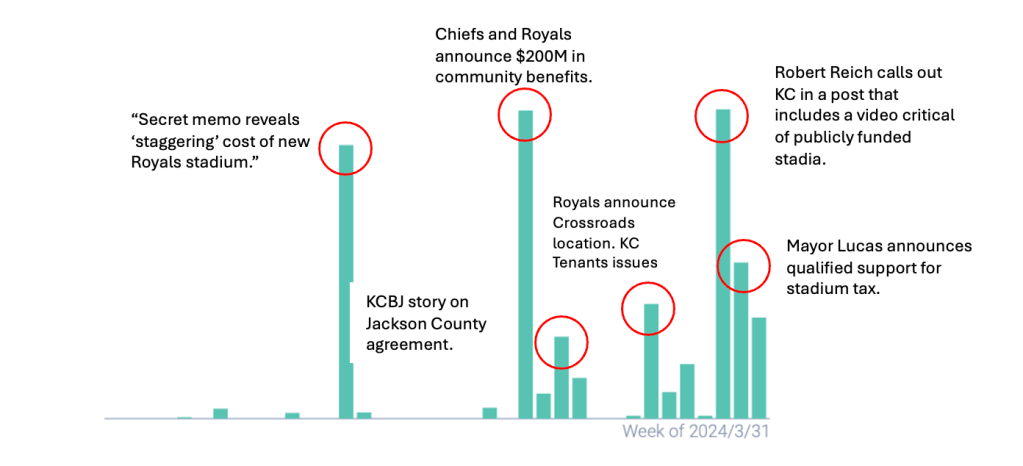
The first big lightning strike came in late October 2023 when The Kansas City Star published an article “Secret memo reveals ‘staggering’ cost of new Royals stadium for Jackson County taxpayers,” claiming that a new downtown ballpark would cost taxpayers between $4.4 billion and $6.4 billion.
The next day, the Royals issued a statement refuting the Star’s claims. Their X post was seen by more than 383,000 people, and received 275 (mostly negative) comments, was re-Tweeted 335 times and liked by 1,400 followers.
Overall social media sentiment skewed negative. And the game was on.
Lightning struck twice in January.
On January 5th, the Royals and Chiefs issued a joint statement announcing a commitment of $200 million in new economic benefits to Jackson County. The backlash was considerable.
On January 18, Jackson County Executive Frank White vetoed a measure to place the stadium tax issue on the April ballot. He was eventually overridden by the legislature.
At the same time, the Kansas City Business Journal published a story examining details of a draft letter of intent between the Royals, Chiefs and Jackson County that outlined the general terms of their agreement pending passage of the sales tax.
In February, the Royals unveiled their plans to build the new ballpark in the Crossroads, a surprise location for many in the community. This announcement set off another round of oppositional posts, led by this statement from KC Tenants.
With each lightning strike, the Royals found themselves playing defense against a well-organized, well-connected opposition, whose ability to engage and amplify one another via social channels simply overwhelmed any positivity the ballclub could generate from its allies in the civic and business community.
The Biggest Influencer in Kansas City is…. Robert Reich?
They say all politics is local, but national figures can and do have an outsized influence on contentious issues.
Robert Reich, the Cal-Berkeley Professor, former U.S. Secretary of Labor and outspoken critic of publicly funded stadia, specifically called out Kansas City on two occasions in March, garnering nearly 9,000 likes, comments, or shares from his 1.5 million followers.
On March 18, under the post, “If the Kansas City Chiefs don’t get an extension of a sales tax that would help finance a renovation of their stadium, they might leave Kansas City. The family that owns the Chiefs is worth nearly $25 billion. This is just the latest entry in the billionaire stadium scam,” Reich posted a four-minute video, “The Dark Side of Sports Stadiums,” which was viewed by nearly 195,000 people. His March 30 encore post attracted 76,800 viewers.

Combined, the two posts were re-Tweeted (“re-Xed”?) a total of 688 times, reaching an additional three million followers.
While we don’t have location data for half of those who re-Tweeted the post, re-Tweeters based in the Kansas City metro alone reached an additional 64,189 followers.

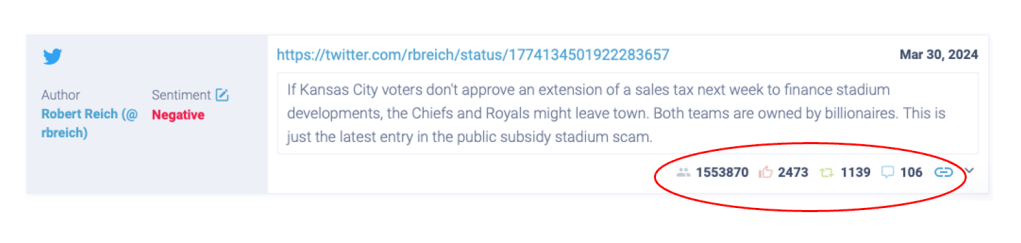
Robert Reich’s standing as a thought leader on public policy issues offered the opposition a highly credible third-party endorsement for their points of view.
Comparatively, the Royals generated significantly less engagement in social media, with a total of 798,810 comments, likes or shares in the one-year sample period.
“Reasonable People” Congregate in Reddit.
I have never heard someone say, “gee, your Tweet really changed my mind on that issue.”
The combination of human behavior and social media algorithms has fueled much of the division we see in America today. We tend to seek out and amplify what we like and either disengage from or troll those with whom we disagree.
Way back in 2014, a Pew Research Study noted six different ecosystems that typically evolve on Twitter, and there’s no reason to believe these same systems do not exist across all social media channels. For example, Democrats tend to communicate with and amplify the posts of other Democrats, and Republicans do the same.
Reddit may be the exception because it is a self-policing platform, where members of selected “subreddits” up- or down-vote others’ posts based on the post’s perceived validity and usefulness. Citizen moderators ensure users follow established decorum.
In the Infegy Atlas sample, Reddit was the second most-heavily used platform, behind X, with roughly 25 percent of all social media posts appearing on various Kansas City-related subreddits. Interestingly, if one eliminates all X posts that were either shares (re-Tweets) or replies, four times as many original opinions were posted on Reddit—making it the largest single source of social media dialogue on the stadium tax issue.
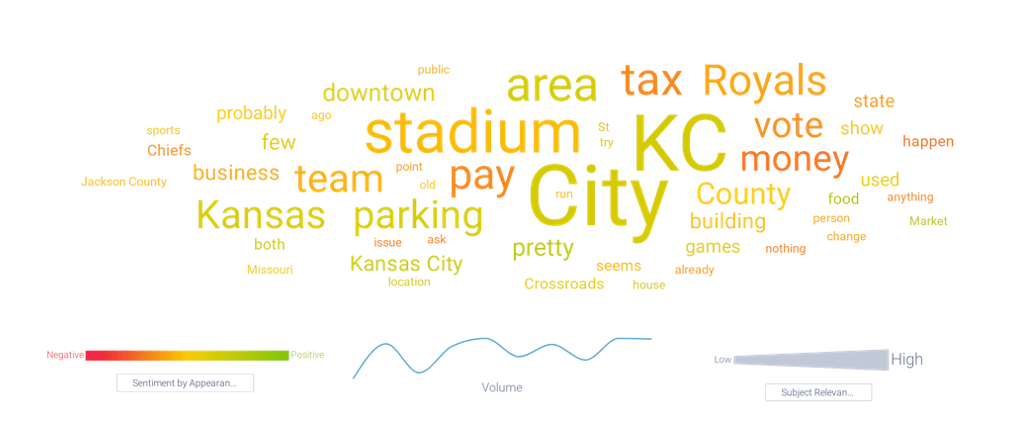
According to the Infegy sentiment analysis indicates 38.6 percent of all posts were negative, 37.5 percent neutral and 23.8 percent positive. Most of these posts called attention to statements issued by either the Royals, KC Tenants, or other interested parties, with each person offering his or her own commentary.
This balance indicates an ecosystem where it’s okay for people to disagree, and where those who make a cogent argument for their points of view have the opportunity to earn up-votes and potentially sway the conversation.
Lessons Learned
It’s easy for someone like me to sit in an office, pore over some data and tell you what happened. Call me “The Oracle of the Obvious.”
But the data clearly show is that the game has literally changed from the top-down communication style practiced by the establishment, and the mob rule that leads much of our political and social discourse today.
As a corporate communications advisor, one thing I can say is that business leaders must understand communications ecosystems before launching any campaign or endeavor.
The second piece of advice is to identify those who would serve as allies and champions for an idea and working ahead of time to rally these people so that they are prepared to not only amplify your message, but also actively come to your defense when the trouble invariably comes.
Last, don’t be afraid to engage when appropriate. Please note: I am not suggesting that one engage with trolls. However, there are still forums where reasonable people gather and where corporate communicators can get a fair shot.
Looking to the future, I am optimistic that I will someday enjoy downtown baseball with my family, even if it’s with my future grandchildren. Kansas Citians are a curious breed, but we have accomplished great things in our community (remember the bi-state support for Union Station?) and we’ll get this accomplished, too.
 Revival